In the really shit 1996 film, Twister (a guilty pleasure that I actually enjoy), the situation is this: We have the protagonists, storm chaser Bill Harding (played by Bill Paxton) and meteorologist Jo, played by Helen Hunt, both aim to test out some new technology, Dorothy, which will map a large tornado. Who’s the antagonist here, in this adventure/disaster flick? The tornado! Mother nature itself, an unstoppable and inevitable force that one can only outwit through cunning and knowledge and technology, but will in fact leave ruin in its wake.
Alright, intro aside, lets get into the meat of this. The modern day defining antagonist of our time is arguably Heath Ledger’s Joker in Christopher Nolan’s Batman The Dark Knight. This character is an archetypal antagonist in that he not only hits the defining points, but he redefines them for contemporary age. The film sets out to ask a question – what would it take to taint the image of a hero like Batman? What’s interesting here is there’s nothing very new about what the Joker sets out to achieve. The Joker has a desire to show that, beneath the superfluous, everyday image of ordered society exists a lie we tell ourselves. Joker wishes to expose that lie and reveal us all to be truly hypocritical, mad, criminal and so on, in order to have the last laugh, showing everyone that nothing matters and that heroes are built on lies. This has very Platonic, Kantian origins, and story tellers have paved out some general rules for great antagonists over the centuries from Greek tragedies to Shakespearean dramas and so on. To use the words of Morpheus who, while explaining the Matrix to Neo, said; “Some rules can be bent, others can be broken.” Our canvas as writers in this example would be The Matrix – or your word document if you insist. And our tools are the imagination, yet it is all based on limits – where we can push and test those limits comes down to how we re-imagine them. I want to try and get you to rethink your approach to the antagonist character.
8 Points to Writing a Good Antagonist
In Alex Garland’s stunning 2018 science fiction film, Annihilation, (incidentally – if you haven’t seen it, go watch it because, spoilers ahead…) you’d be forgiven for believing the antagonist of the story is the mutated bear or the alien species that appears at the end. Indeed, the alien is a force of conflict, but what the alien demonstrates is that we humans are the ones standing in our own way – we’re self-destructive, or at least we’re a species of destruction, and somewhat conscious of it, (knowledge that turns out to be redemptive once the protagonist catches on.) The enemy here is not the alien, but us, ourselves, as demonstrated in this masterful scene that looks a lot like contemporary dance. In order to survive the alien, the protagonist must understand and confront her own intentions. (Sounds a bit Jungian, right?) The antagonist can be a psychological tour-de-force. It can be a specter, or an idea – or someone able to manipulate technology to achieve both, as in Fritz Lang’s The Testament of Dr. Mabuse (1933).
Good antagonists must subvert the protagonist’s impetus. Like cat and mouse, Sherlock Holmes must be forced to demonstrate his skills to uncover his greatest foe, the illusive and cunning Moriarty, who plays-off these traits. So, here’s some tips to consider when venturing out on the fun and exploratory journey of writing good enemies.
Is this the right villain for the story?
Would The Joker fit well in another film of Christopher Nolan’s, Interstellar? Imagine – the earth is dust and the Joker has been sent to space to find astronauts who have landed on the new home-worlds. The situation here is already bleak as nature is destroying humanity – leaving nothing for the character to do but agree with the already nihilistic perspective humanity is facing. The Joker can’t flourish here – he himself has to survive. We need an antagonist like Dr. Mann, a great mind left on a planet in deep space who truly believed his planet would be the next home world – only to be fundamentally mistaken. Such a blow has brought him to a deep, fragile, place, something he probably hasn’t felt since being a child – as such, Dr. Mann tries to reassert his authority in desperate situations that unintentionally lead to disaster. Dr. Mann is perfect here – he isn’t an intentional antagonist – he’s a rational antagonist. A man on a mission. Someone who doesn’t see his own hypocrisies yet asserts his authority due to some misplaced experience or knowledge over his other peers.
Ask yourself this: Is your antagonist fit for the situation your novel or script sets out to answer? Is this the right person? Why? What kind of person can you imagine being unleashed to answer the main premise your novel sets out to answer? What can they bring to this journey?
In the Rick and Morty episode The Vindicators 3, season 3, our “heroes” get a call to adventure to try and stop a mortal enemy, an evil alien overlord called World Ender. The foe is presented as an unstoppable threat – this is quickly undermined when somebody has killed World Ender, giving us a more terrifying enemy. Drunk Rick. This is completely within this character’s spectrum, we believe Rick would be able to achieve this – and that he’s such a complex character, acting as a foil to Morty’s own ambitions as well as an antagonist, we are invested and believe this to be typically Rick. Which leads us to character consistency.
I don’t believe it! Consistency
 When we see Agent Smith dodging bullets and thousand-chain-punch Neo to the ribs, we believe it. Not because what he does is believable or realistic – we believe it because we know the stakes, the limits of the Matrix, and who those few characters are that can manipulate the rules. Always ensure your antagonist is visionary and powerful – BUT, within reason. Rick is a dangerous power since, when drunk (which he often is) he is so deeply self-destructive and nihilistic he waives all life as pointless – Rick is his own worst enemy, he has made his own rivals along the way.
Agent Smith can bend the rules but he can never be free like Neo to understand those rules and fundamentally alter them. Give your antagonist blind-spots. You must know your antagonist well enough to understand their limits and weaknesses, even if the protagonists never discovers these weaknesses, as a writer, you must now them. Just like nobody wants a “Mary Sue or a Marty Stu” protagonist, nobody wants a Super Man antagonist either. Even super villains like Thanos must exit with scars – even when they win. We can only be invested in those we understand to be flawed in some way.
Immovable Object
In the 1989 horror sci-fi classic, Alien, I used to believe that the real antagonist was The Alien itself. In more recent years, I’ve come to understand that it’s not the creature on the USCSS Nostromo that was the antagonist – it was the android, Ash. He was Ripley’s immovable object. Just like the alien, he worked in the shadows. He used his intellect to gain her trust, psychologically manipulating her, gas-lighting her, second guessing her authoritative decisions along the way. He was the force that brought her up against her nightmares. If Ripley was the safety engineer, the alien was the infestation, but it was Ash who kept lifting the controls on situations Ripley was able to manage. It was Ash who was cultivating and guiding this force towards Ripley despite her best efforts to contain it. And in their final confrontation, Ash was at one point in the film, quite literally going to kill Ripley himself. The alien is their drive, their goal; Ash wishes to contain it, Ripley wishes to destroy it.
Going the Distance, Small Victories
The antagonist doesn’t have to be around in the whole story – (so long as you don’t do something stupid like build up your antagonist as a great and immovable object only for a short reveal before cutting them down while leaving absolutely no future influence left to ripple through the story other than a whimpering word of a name.) The antagonist needn’t be there from start to finish, poking the protagonist along the way. But they must propel them, they must set things in motion that keep going, even if they should prematurely exit stage. They must give your hero the greatest of challenges, and in some way, they must succeed. Antagonists have their own agenda, but once they find their opposite (protagonist), they must set an example of them and put their ideas to the test – for whatever reason, this should be the case, necessity, ideology, embryonic-test-subject, desperation to reassert one’s values, understanding a species…be imaginative!
Nuances – Evolution and Alignment
This kind of antagonist is normally found in series that are seasonal, such as Breaking Bad. As an audience, we understand the character’s changing history. We see the journey, start to end. We witness their evolution. Often they surprise us. But we can also understand different types of antagonists – if they’re lawful, like Darth Vader. If they’re Chaotic, like Joker, if they’re a Natural evil, like Alien. It’s always worth getting a fix on your character’s Moral Alignment and adjusting it to the particular story you wish to tell. This takes thought and planning, so, think first about what you want to say and who you’re saying it to. (More on that next time.)
Evil Power: What Works
As mentioned earlier, you don’t want to overpower your character. They must climb their own ladders, overcome their own challenges, and in each step it must resolve their reason. If their power is cunning, they might, for instance, be unsuspecting of the worst deeds – they may still have some surprises in store. They may still surprise even themselves. Stepping outside of character in order to reposition their morals and philosophy is fine, so long as it doesn’t contradict their aims and natures too much – it can even be where their hidden power resides.
Their decisions must make sense and relate to these advantages. Does it make sense that the antagonist suddenly reveals they have psychic abilities when this was never expressed earlier? Don’t shape your character to fix your story – let your story reveal and resolve your character.
The Villain’s Journey
In much the same way as you’d approach a protagonist, the enemy should also have a journey that has strong beginnings and concludes in a way that is befitting of the character. Get through their whole history – and consider where is it best to begin the antagonist’s story? Where will they enter stage? What will it say about them? At the end of Batman Begins, The Joker is presented on a playing card, foreshadowing what’s to come in the next movie before exploring the philosophy of this character.
The Joker appears as a force to counter Batman – almost out of nowhere. His origins are mysterious. In Shakespeare’s Macbeth the antagonist is also in fact the lead role – his lies catch up with him, his crimes reveal his true intentions, his origins start with temptation. In Tolkien’s Lord of the Rings, Sauron is a warrior of legend, we see aspects of his scattered over the world, haunting them even after his defeat. In Charles Dickens, Great Expectations, Miss Havisham is an antagonist of tragic origins that have twisted her into bitterness and hatred. What is the face of your antagonist? How much will you reveal about them? The Joker lies about his background – further demonstrating his unreliable history to state firmly it doesn’t matter. Yet it’s the lie itself that is important as this tells us enough about the character. What will you reveal about your antagonist? What will it say about their history? Their philosophy?
The Big Lie – Leaving Room
Often, the lies uncover the truth. The lie in Dark Knight is the hot potato being passed around so society can continue to function – who is The Batman? The lie in Macbeth is the initial murder of the king at Macbeth’s own hands – where is the real killer? In Great Expectations, Pip is not privy to Havisham’s cruel intentions, his story encompasses the lies of other characters slowly unraveling. In this way, our lies function to maintain the order, something often true about society. What happens when a truth is discovered? What hinges on a lie and how does your antagonist wield this power to their benefit?
Follow these tips and you can’t fail to flesh out a basic antagonist. As a further note, writing your story fully develops your character and resolves their destiny. Leave room for change. As your antagonist works to expose the faults in your other characters and challenges their beliefs and proclivities, they too must be able to change in some regard (unless you’re writing a sit-com; in which case the characters never develop and mostly always reset to original conditions upon the conclusion of each showing.) A good story can challenge your antagonist too and leave room for development and challenge. We don’t have to sympathize – the challenge might be an assassin failing to kill their target due to oversights. Remember what you’re setting out to achieve and ensure your antagonist fits the bill.
Have fun tip-tapping, writers!


 If I said that this is our world today! It is a neoliberal one! Our society is a neoliberal capitalist paradigm – would you better understand it?
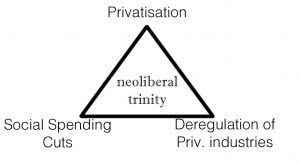 Normally, these ideas emerge during a crisis or shock, since people will be busy with their worries and concerns about how to fix the crisis, they will be looking to leaders for answers. So the arguments put forth are in line with Margaret Thatcher’s age-old phrase: “There is no alternative.”