
So, you’re a writer – and certainly, you’re going to have to read. Lots! Read daily – as much as you can, if you’re not already in the habit. If you’re a young person reading this then reading is going to be a lot easier, since the luxury of time ought to be more available to you. For me, reading was a pleasure I did daily. I used to read at night before bed and on the bus going to college. Am I still in the habit? Of course – but how I budget time today is very different.
What we find when we read is that we are informed on our writing. We consult great voices who share with us their humour, their outlook, their wit. What we have collected is perspectives!
When American novelist Jonathan Franzen interviewed Professor of English and Linguistics Shirley Brice Heath at Stanford University, it was made clear that a reader (an isolated person in this particular conversation, who as a child believed they were different and thus sought inclusion in imaginary worlds) can form a dialogue with authors.
What happens is you take that sense of being different into an imaginary world, but that world, then, is a world you can’t share with the people around you – because it’s imaginary. And so the important dialogue in your life is with the authors of the books you read. Though they aren’t present, they become your community.
Steven King says this even more imaginatively. In his chapter On Writing, titled: What Writing Is, Stephen King says:
Telepathy, of course…All the arts depend upon telepathy to some degree… (After elaborating examples on description and visually relative variations, he goes on to say) This is what we’re looking at and we all see it. I didn’t tell you. You didn’t ask me. I never opened my mouth and you never opened yours. We’re not even in the same year together, let alone the same room…except we are together. We’re close. – We’re having a meeting of the minds.
Other writers are your community. Their voice is with you and instructs you. Reading is part of the dialogue or opening your mind to their work, their voice and their dreams.
Those lonely and pained and often isolated people, those who have felt different and never really fit in, they are speaking with you if you feel the same. (Like mine-craft is a digital community, reading is the mind-craft community. We expand our dreams through the inspiration of others, we read – we’re guided, and improve our imaginative vision).
If you want to be a healthy writer – you’re going to need nutrition!
How much of what I write am I ripping off?
When I was younger – I wanted to be truly unique and original. I wanted to deliver something totally unheard of before, create something totally weird. Alas, that’s impossible, of course I didn’t know it then. There are limits to how we are informed. Sure, a heavy dose of LSD might blow your mind into a new dimension but putting that into words might be difficult since language is a limited and time-consuming process, not to mention the workings of human imagination are simply not always categorised by words – so we move slowly as language changes and evolves with us. Evolution is necessarily slow. We are influenced by our environment and what we know. What we do about those elements is all down to how we play with them (bending, blending and breaking!)
American novelist John Updike famously stated: “My purpose in reading has ever secretly been not to come and judge but to come and steal.”
This is the nature of consumption, contemplation and reproduction. Artists take ideas – sometimes counter ideas and to use the Hegelian term, synthesise them. Hegel’s philosophical idea was that when an idea is lying around, a thesis, then its very nature calls into existence its opposite, the antithesis, so those two conflicting ideas merge and forge a synthesis. The birth of this new idea (or synthesis) itself becomes the new thesis and calls into action its counterpart and so on.
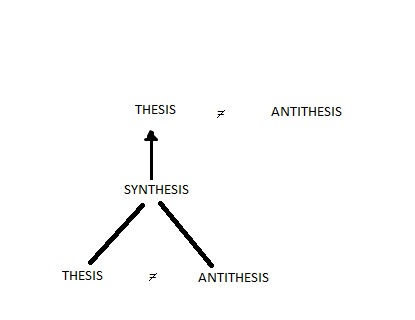
So, how much of what I create is me? Probably not a lot. Even to the very small minimal you’ll find that your inspirations and your guides are leaking through.
John Gardener argues:
All great writing is in a sense imitation of great writing. Writing a novel, however innovative that novel may be, the writer struggles to achieve one specific large effect, what can only be called the effect we are used to getting from good novels.
Look at your most beloved books and synthesise ideas! What is it you love about them? What compels you to keep coming back and reading them?
Making Sense of Lit
A student of literature is trained in critical vocabulary necessary for analysing texts and taught to interpret and seek out themes and tropes and stereotypes and meaning for a deeper understanding to literary theory. It is of course possible to do this without being a student of literature. Generic texts such as horror and science-fiction will have some underlying thematic topics such as mystery or dystopian and they normally explore ideas using nature as description or life and consciousness and so on. What we as writing readers need to learn to do is to discover the sub-text, the hidden meaning, the metaphorical picture, the cryptic problem the writer struggles with and expresses in their prose. Once you have learned to decode the writer, you have found the proverbial easter-egg of their problem.
Sometimes, writers aren’t looking for challenges, sometimes they’re looking to plug a generic market gap and are writing simply to cash-in. Christmas is coming, or maybe it’s romance time? (Actually, we’re close to halloween at the moment and if you want a creepy, Lovecraftian horror novel, check out The Crawling – Promotional Offer starts 26th of Oct and runs until the end of the month.) But not all literature has a double meaning, but one could argue even the commercial and surface literature is telling as to what popular and cultural attitudes and tastes are in swing during a certain time and season. (Often the phrase sex-sells is always true no matter the season…I’m looking at you E. L. James!)
The timeless literature is something you know how to look for as a broad reader, remember, experience informs intuition!
Novelist Joyce Carol Oates believes that:
Our reading is a part of our preparation for writing…Every book, every sentence we read is a part of our preparation for our own writing.
Reading and analysing literature is in this way a part of a writer’s apprenticeship!
Included in this article is a resource pack for vocabulary useful for analysing text. (From the Ilfracombe Academy English Department. I wouldn’t worry about getting academic about this. Actually, this is worth reading simply so that you are familiar with terms and themes writers often unconsciously employ, and the vocabulary literary critics employ to break it down.)
When it comes to your work as a writer, and lets say you didn’t study creative writing or literature – don’t worry about it. Get on with it. This is not outside your realm of understanding. This is your world, and you can make it any way you like. How you show it, is down to what you want to say – and what you learn not to say. Sometimes, a silent key brings depth to a piece of music – and in writing, less is more. But more on that one another time. To conclude today, I would like you to consider some elements of craft:
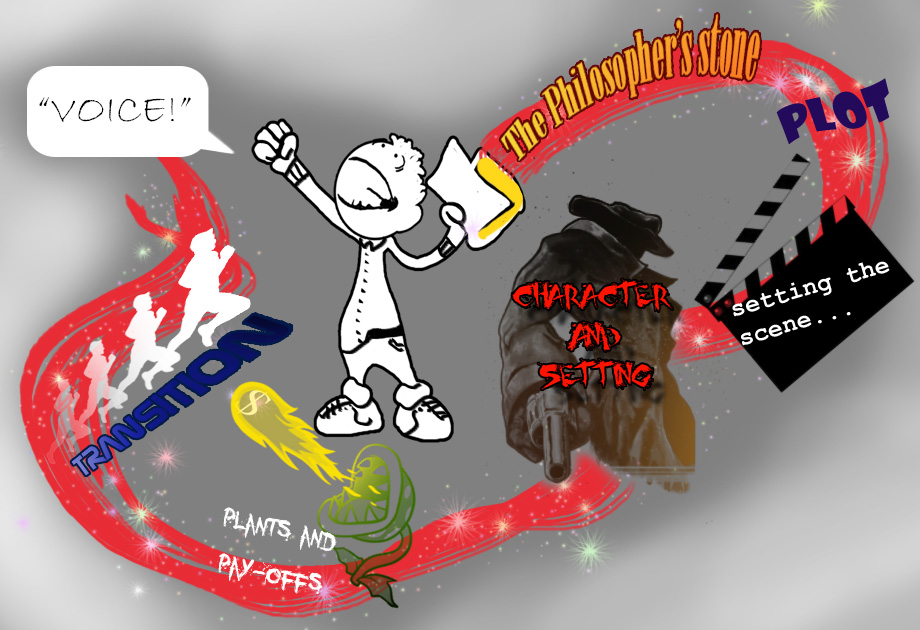
- The (Philosopher’s) Stone (Your issue – the subject you’re taking on and how it will evolve throughout the trans-formative process of your story’s arc)
- Plot
- Setting, scene, pacing
- Characterization and dialogue
- Plants & Pay-offs (everything mentioned has its purpose, no holes or gaps, no strings untied)
- Transitions (the art of segue)
- Voice (defining your craft)
A good writer can capture emotive words at appropriate times. If you haven’t come across the pathetic fallacy yet then I’ll discuss this further in later articles. Essentially, you want to attribute emotions accordingly, target emotive words and get used to seeing them and feeling them and being with them. The next time you’re comfortable with a cup of tea in a warm place, find all the sysnonyms you can to colour that situation and sit with them floating in your mind. Having a grasp of emotive words will keep your reader interested, but more than that – it will help you to reach your reader’s telepathic state and relay to them the moments you’re talking about.
Quick exercise: We’re going to look at how dialogue maintains tension. Open Youtube and checkout a great channel called Screen Lab (there’s also Script To Screen and they’re both worth subscribing to for case study scenes). Perhaps you know this extract, perhaps not: This is the coin toss scene from No Country For Old Men; AKA -“call it!” (Click the hyperlink text – also the script is included in the resources at the end of this article.)
This is a script extract and the actors largely carry the tension, however, if you follow without audio you can sense where the writer was going. I’m going to assume we’re all an audience who knows that Chigurgh is a psychopath, we know he’s ruthless and industriously resourceful in his killing methods. We know that the poor proprietor is in trouble. But now – put all that information aside and read the script again. This manner of speaking is aggressive and predatorial on one side. It builds tension! Coming into this dialogue blind to any previous information, we don’t know what trouble the proprietor is in, which isolated, makes it a curious case-study. We have a confused and defenceless man at a cash register now faced off with the devil, trying to worm his way out of a conversation that is taking a direction now completely out of his control.
The subversion here is the dialogue itself. There’s no brutal murder. There’s no horrible blood and guts, shotguns blazing and heroic face-off. But the tension is compelling. The communication between these characters expresses a power-dynamic. One is insulting because he knows he holds all the cards. You can almost sense the antagonistic character’s resolve here: I can kill you – you didn’t know it before, but I’m going to make you know it now. That mouth of yours, you’ve been so loquaciously flapping all these years – I’m going to get it talking for a purpose now!
The tension comes from what’s at stake. There’s a coin toss – (uncertainty – a 50/50 result that brings the bar right up to its equalizer – one half is death!) The stakes are high! There is nothing this man can say to escape this fate because he is a target – and it came so innocently as a nosy bored old man daring to observe where Chigurgh had driven from.
(I use movies because visual media is much faster to convey larger concepts. The same ideas works very well in novels, and there’s many great examples there too, of which I’ll be discussing in later features)
So, your writing task? – Build tension! Consider timing, consider circumstances. What’s at stake? A future? A person’s history? Reputation? Life or death? Think about characters – what type of person would suit each situation? (it’s not exactly fitting that a librarian should be bothered about loosing a javelin throwing contest).
Finally, think! What is your favourite moment of tension in a movie or on theater or in a book?
Get to it writers and enjoy!
(References)
Joyce Carol Oates, Telling Stories (New York: W. W. Norton & Co., 1997) P. xv.
Stephen King, On Writing (Hodder and Stoughton, London, 2000), p. 117
The Script Lab, 2017, Nov. 17. No Country For old Man / Coin Toss. Retrieved from [https://www.youtube.com/watch?v=SYNgFU30pUk]

Leave a Reply