
Purpose and Meaning in the Fall of Empire
Walking through Warsaw city centre, I passed two street musicians playing Winds of Change by The Scorpions on bagpipes and electric guitar. It was a hauntingly beautiful cover that got me thinking, perhaps the spectres are once again on the move around Europe. We are without a doubt in a significant paradigm shift, one that will decide the fate of humanity’s future on this planet. Living in the shadow of rising authoritarianism is one aspect of it. From runaway AI to spiralling climate change, times are increasingly chaotic. Finding purpose in the fall of an empire has never been more crucial – and to do that, we must be willing to revisit rejected ideas.
Great Political Lies: The Fall of The Soviet Union
The Winds of Change was written at the end of the Cold War and the fall of the Soviet Union. The message envisions a world united in peace and prosperity, a sentiment echoed just 3 years later in Francis Fukuyama’s 1992 essay The End of History and The Last Man. Neoliberal capitalism emerged as the dominant global ideology, with the United States leading the world as its hegemon.
Before Soviet Union fell, the great political lies of Technocrats broadcast daily, asserting their control was absolute. Adam Curtis explores this further in Hypernormalisation, a phrase coined by anthropologist, Alexei Yurchak. In 1990’s Russia, people pretended everything was fine, bolstering a fake world based on political lies. Even after the Soviet Union collapsed and neoliberal reforms of mass privatisation swallowed state assets, this behaviour persisted. In the midst of a capitalist shakedown of Russia, opposition leaders locked themselves into dreams of the past while oligarchs ransacked the nation. The future was cancelled.
Today, something spooky is happening. A sense that our own political technocrats are lying to us. Moreover, they know that we know they’re lying to us. They enact a post-truth ‘there-is-no-meaning’ playbook, whereby power asserts truth and everything else is conspiracy. Presently, we face our own Berlin Wall moment – but instead of ideologies falling, what threatens to collapse now is the very planet’s life systems we all depend upon.
We carry on because we don’t know what else to do.
In the words of Thatcher, there is no alternative.
Restoring Alternatives to Cherrypicked Ideas
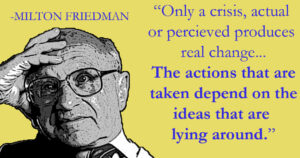 American laissez faire economist Milton Friedman was correct about crisis acting as a catalyst for change. What he neglects to mention is that the ideas lying around are cherrypicked and highlighted to hide alternatives. Freedom, one of the great tenants supported by free-market economists, entails competition. But when we highlight the benefits of free markets, we hide the unregulated hand that amasses enough wealth to monopolise and crush competition.
Indeed, in much the same way freedom is twisted to mean the freedom of corporations to crush the vulnerable, the ideas laying around are not for discussion. Ideas must be cherry picked and approved of by bloated private conglomerates, shifting alternatives out of sight. The ideas lying around are the ones that favour the neoliberal agenda for the oligarchs controlling the political arms of mass media. What is considered acceptable discourse is framed and repeated ad nauseum.
The Invisible Sleight of Hand
Power is necessarily deceptive. It’s a magic trick, a sleight of hand that reasons total control in order to exploit vulnerabilities in anybody challenging its structure. Its mandate is made to sound reasonable. When its narrative becomes broadly accepted as truth, the argument is considered won. That’s when the strategy changes. Ideologically, people are cornered and left with a false dichotomy Milton Friedman frames as Freedom. Red or blue? Left or Right? God or Master?
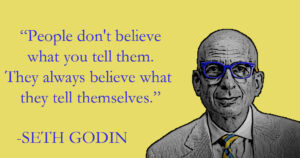
The old marketing trick is to evoke a powerful feeling in people, for example anger or nostalgia. When you do that, people believe they own something, so long as you make them believe it was their feeling and their choice. Seth Godin put it best; “All marketers are liars.”
This sleight of hand operates everywhere, from consumer choice to voting . Neoliberal capitalism tells us the story that humanity is essentially a greedy and selfish animal. It naturalises the system’s overreach into our personal spaces. In terms of boundaries, we surrender our real freedom to this perplexing system for a chance to win a type of lottery framed as ‘wealth’.
However, if there is a hand working to make anything in this world, it is the unnamed programmers writing code for the corporations. It is the countless shop assistants keeping stores open in a global pandemic. The journalists delving into tedious trade jargon to discover injustice. It is the hand that drags our morning bins to the crusher or wipes our windows. The hands that deliver food on the cold dark nights. The common worker is the true wealth of nations, a fact that is once again haunting our conscience in these dark days.
Imagination VS Silicon Valley
Ideas are not born in a vacuum. They emerge from research and discussion to first conceive what is possible. Silicon Valley’s ethos of move-fast-and-break-things is a divide and conquer strategy. That is to say – if you wind up homeless one day with a smartphone running an AI self-help protocol, you weren’t lazy – you were robbed. The smartphone acts as a digital portal, allowing you to till the cyberspace fields of Uber delivery et al. Tech broligarchs would have you believe any advances in consumer technologies clearly symbolises wealth. In reality, the tool chains you to the gig-economy, scrambling for basic needs.
In the 1990’s, the Cyberpunk genre explored themes of authoritarian corporate dystopia as a warning. That our Silicon Valley gurus treat it as a roadmap points to a deficit of imagination. Tacitly, these cybernetic leaders ground their businesses from their favourite science fiction stories while they worm their circuits deep into the fabric of our reality, redefining it to the point of psychosis.
Cybernetics and the Tech Wizards
Cybernetics has always been about control. The very word cybernetics harks back to its etymological root kybernētēs, meaning steersman in Greek. The term is attributed to computer scientist Norbert Wiener in the 1940’s, a significant contributor to communication control. Today, Silicon Valley’s influence embraces that control with a religious zeal. If entropy is the natural state of the universe, their calling is extropy.
For years, I studied the Nick Land gurus and Kurtis Yarvin tech wizards, watching them weave their dark mythology into the mainstream. Their philosophy embodies an occult-like narrative that envisions an unimaginative future of cybernetic CEO kings ruling over cyberstates. Their general AI answers to the wealthy and regiments a working class majority into an unenviable digital feudalism.
Are we surprised to learn this? As Karl Marx correctly observed, Capitalism emerged from Feudalism, meaning this rebound, albeit with the glittering embellishments of quantum computers and AI, should surprise nobody. By unlocking reality, the so called Masters cast aside their material shackles. These extropians believe humans evolution belongs to spiritual machines, ascending to a new heaven sustained by the siren servers of a new earth.
On Imagination – Epithemeus X Prometheus
You’ve probably seen the quote by Einstein regarding the importance of imagination. However, keep in mind that Einstein was an empiricist concerned with observable facts. When discussing one’s ability to imagine, Einstein was tapping into an intuition based on knowledge, not imagined out of context. If capitalist neoliberalism is the Epithemeus (afterthought) of unplanned governance, mindless transactions and consumption, then let our purpose explore the Promethean (forethought) of new societal behaviours. By observing the trends in today’s paradigm shift – we can open Milton Friedman’s lockbox and revisit the ideas lying around. In this way, we may intuit and imagine profound new realities, with an evidence based direction.
Dialectical Materialism: Nature and the Technosplit
Returning from Warsaw city by tram is simultaneously romantic and overwhelming. In terms of relativity, we’re all moving through space as individuals, contemporaneously atomised and present in shared experiences. Morally, we’re not all on the same wavelength since, our brains do not process or reason abstract ideas the same. Yet, one thing I see so often is an understanding of compassion. A mother caters to her child. A man offers his seat to a senior. A tired worker zones out to their music. A youth snapchats friends. When threatened, we subconsciously huddle closer the way nature intended. Even as the subversive threat of the techno-virus tries to keep our conscious minds apart, we seek connection.
In his book, The Patterning Instinct, writer Jeremy Lent expands upon a concept called the Technosplit. In one hand, the radical transformative ability to experience the life of a poor person could spur an empathic response. But if we consider the recent AI trends atomising our realms of experience, it’s not hard to see how experiencing the life of another may be regarded as entertainment by wealthy neuro-tourists.
A dialectics on Nature
We can’t assumed that those controlling and benefitting from technology will ever act in the interest of all. It is worth remembering that the electrical spark is the balsam of nature, and nature is the final dictator. Working against reality entails our undoing. Today’s dialectical materialism should align with nature, wrap it around us like a nest.
When I think about the tram on my way home, I recall couples huddling around their children, and I am inclined to remember why we sleep. Nature encourages our rest, to recover our strength and know love through warmth, while the machine will work us to death and deny recovery. If it is the will of broligarchs to split from nature, may we explore alternatives and see how technology and nature can flourish symbiotically.
New Concepts in the Fall of Empire
I got home that day with a chill in my bones, quite typical in the flu season. My dog, Murphy, greeted me at the door wagging her tail. Loyal, comforting, loving and, yes, hungry. I rubbed her belly and cuddled her…I knew her needs and she knew mine. Emotions are like that, aren’t they? They resonate like unspoken connections.
Shivering and sniffling, I settled in with a warm tea, put on my music and organised my thoughts.
Ideas propagate like waves. In a sense, there is a collective zeitgeist in the air, something we all feel, something very different this time. It’s both optimistic and terrifying. But we got here in the first place because we believed there was something special about us. As the planet burns and we weep for new worlds, we should utilise some lessons from the manosphere self-help gurus and change something. It’s time to ground our feet and put aside the broligarch’s future. It’s time for a spiritual split with the values that got us here, and slowly, piece by piece, build a new chapter.
Earth Emotions
In his book Earth Emotions, Glenn Albrecht conceptualises new definitions for human feelings hitherto unexperienced. These new terms define feelings about nature and environmental crisis, with the intention to forge a shared understanding and renewed relationship with the planet. Humanity’s extropian path doesn’t need to express itself in accelerationism. Nature should take its slow course and we should follow her lead in awe of the things this process may show us. Insofar as we have control, and perhaps, as limited as it is, there is still time to direct it as I believe, we should make today a meaningful one. In all this mess of our daily lives, flung clothes, whirring washing machines, endless scrubbing, cleaning, cooking, dusting, there is love. What greater reason can we find than that to steer our lives and be the kybernētēs of our destiny than that?
Watering the Desert of The Real
I love to read and write science fiction. However, in truth, I no longer concern myself with the future. Instead, I see today more clearly than I have ever in my life. And when I reflect upon today’s potential, I’m reminded of an old Greek proverb:
A society grows great when old men plant trees in whose shade they know they shall never sit.
The Capitalist Realism of no-alternative is fraying on the cliffs. Unless we pull up our sleeves and propose better ideas, then we are doomed to sleepwalk into a cybernetic authoritarian nightmare that parallels the cyberpunk dystopias, only in a more janky and less theatrical way. In his book, Welcome to The Desert of the Real, Zizek explores how the 9/11 attacks on the World Trade Center exposed the contrast between our symbolic world and the Real world, rupturing the structural narratives that once seemed so pervasive and reassuring. Then, in 2008, the neoliberalism paradigm officially died.
Undying Ideas Unexplored
Today, it’s necessary to prop the corpse up with a bloated reality TV show star and serial conman spouting strong man rhetoric and threats. That’s because the fading of this End of History paradigm is a devastating blow to the long-held assumptions about humanity. Its walking dead iteration has sparked a nerve in Frankenstein’s monster – and an undying idea is finding new expression in the ideas laying around.
Our opportunity demands we think, assess and act on what we know works for the betterment of the planet and thus our human wellbeing. Our evolution and healthy maturation may be to reflect upon what benefits capitalism provided, note where it failed, and decide upon the idea lying around. We can water the desert and make something unforeseen of humanity today. Let’s heed the spectre haunting us, before we become the bones scattered in the desert.
Sāwlsplit
I’m jotting down ideas and shivering under a duvet when my playlist suggestion goes astray and Peter Gabriel’s Solsbury Hill plays. I’ve heard the song a dozen times before and yet this day, the words landed like an epiphany, bringing me out of my miserable condition. Just like Winds of Change, this is a song about new beginnings. What are coincidences but moments of opening to new ideas and finding patterns and connections in the flowing ether of our lives?
Creative splits
For the uninitiated, Pater Gabriel was once in the band Genesis. For years, he contributed enormously to the band’s creative direction and tone, until studio executives demanded a clean, less performative, radio-friendly sound. Gabriel struggled for years, but the breaking point came during the birth of his first child. His baby daughter spent the first month of life in an incubator, her chances of survival low.
With Genesis gaining momentum and adding pressure to his personal life, Peter Gabriel made his priorities known. With a heavy heart, he left the band and chose love, creativity and a chance on imagining a new direction. His reality took an alternative tangent.
In the same way, we in the West face a similar dilemma. Do we dare to imagine for ourselves something unique and bring with us the spirit of our journey? In his book, Techgnosis, Erik Davis defines the soul as a creative imagination that perceives the world as an animated field of powers and images. Perhaps as individuals and communities, we can disengage from the Technosplit and embrace a Sāwlsplit, taking a new creative path for ourselves as individuals and in society.
Today: Renewed Human Truths
I don’t know what the future holds. I know that our obsessions can often bring about unintended consequences. Our planet is on a very serious trajectory toward mass extinction, and yet, it’s still possible to turn things around.
As the Empire collapses, a golden throne melts in the night atop a marble and sandstone house. We hear the soul-seeking entitled tantrums of a sunsetting leader propagate through cyberspace. That all this should all fold in on itself during the tenor of a shameless, malignant narcissist, whose greed for opulence knows no limit or regard for humanity is an epic tale of Shakespearean proportions. Let us remember, however, this man was a symptom of a larger systemic problem.
We can break with that problem today. Even if it hurts. Because new life brings pain as well as purpose. So lets keep history going again, reflect on human wellbeing and restore alternatives worth living for.
When illusion spin her net
I'm never where I want to be
And liberty she pirouette
When I think that I am free
Watched by empty silhouettes
Who close their eyes but still can see
No one taught them etiquette
I will show another me
Today I don't need a replacement
I'll tell them what the smile on my face meant
My heart going boom boom boom
"Hey" I said "You can keep my things,
they've come to take me home."

- Peter Gabriel
Solsbury Hill

Leave a Reply