 If I said that this is our world today! It is a neoliberal one! Our society is a neoliberal capitalist paradigm – would you better understand it?
What is it to be free? We think we know. We’re supposed to believe that in a free society we can express our opinions – and that this matters more than leveraging any democratic control over what happens in our society. We’re supposed to believe that if we vote every few years – it is a bastion of freedom, because compared to those countries that are rendered volatile under dictatorships and communist ideology, we come out on top. It’s enough. It’s the best we can do and that’s why we do it this way. Too much freedom leads to anarchy, too little leads to communism.
Today’s capitalist model is leaning far away from the utopian dreams and fancies of its early proponents. Adam Smith believed the natural tendency of the industrial revolution, if left undisturbed by Government and allowed to flourish, would eventually free humanity. It was understood that the factories would make everything automatically – that humans would benefit from the commodities and finally be liberated to enjoy freedom to think and create. The old Whig believed that a human trapped in repetitive labour was doomed to become a dumb animal who would never happenstance upon anything novel or learn new things if they were to remain trapped in cruel working conditions. It was only natural, therefore, to liberate the human spirit in its entirety.
If Adam Smith could see today’s world he would scarcely recognise it. The institutions that power society today are now operated by computers and we are managed by complex market forces that somehow dis empower us in small ways and direct our behaviour. How did all this come about? Is this really the promise of capitalism? What happened to those dreams of reaching for the stars? The visions we had from the 60’s to the early 80’s of new worlds, of achieving that illimitable place. And why does everyone talk about liberty and liberalism – as though it is a bad thing?
NEOLIBERALISM DEFINED
When asked about neoliberalism – Noam Chomsky has often pointed out in many books and discussions that the name (a compound noun of neo – new, and liberalism – freedom) is an intentionally misleading one since its ideas are premised on policies and practices that are neither progressing freedom, nor are they new. What becomes apparent when analysing neoliberalism is that it refers to a set of actions used by wealthy elites – who often say the believe in freedom. But, the crucial difference is that freedom (liberty) is not the same notion we think of when we discuss freedom. The liberty of the elite is to shake away the punishing burdens of being taxed by governments, moreover to crush worker unions and the rights to even crush communities when it suits their profit margins. Neoliberalism functions to erode democracy and promote private liberty, working to seed suspicion of government in people’s minds and undermine any public consciousness in believing they have any governmental leverage – that we should be suspicious of planning and organising as such tasks can never be accurately predicted and it reeks of communist central planning.
In her brilliantly insightful book, The Shock Doctrine, Naomi Klein identifies the three pillars of neoliberalism’s functions – deregulation, cuts to social spending and privatisation. These come under a set of policies known today as austerity. Since it is not easy to simply go ahead and start applying this practice without mass protest and push-back, there has to be a strong argument made for them. 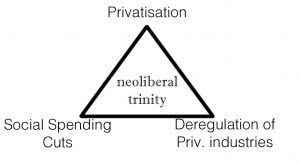 Normally, these ideas emerge during a crisis or shock, since people will be busy with their worries and concerns about how to fix the crisis, they will be looking to leaders for answers. So the arguments put forth are in line with Margaret Thatcher’s age-old phrase: “There is no alternative.”
When the government stops spending public taxes on the country’s infrastructure (road repairs, council matters, local utilities, hospitals, etc.) then what happens is these services begin to strain. When this happens, the government in power (this is normally a government highly influenced by neoliberal policies and working in the interest of big business) will suggest selling off these ‘failed’ public institutions. What is actually happening, however, is they are sabotaging them under the pretext of a crisis scenario.
To prevent any repercussions, deregulation ensures that private industries are not checked and troubled about their taxes and their off-shore accounts (a glimpse of which was disclosed by the Panama Papers.) Deregulation might sound good to people since it’s about shrinking the government and allowing the free market to flourish so that people can easily trade with one another without government interference. However, what people don’t fully grasp is that deregulation is not for the SME segment or Mom-and-Pop stores. Big business will be allowed to apply their cut-throat strategies, using their financial might to buy-out and overpower medium and smaller businesses making a name for themselves so that they can secure their market position while crushing potential competition. Deregulation means that no busy-body government will step in an prevent this process. It means that market discipline will be applied heavily and at great cost to smaller, struggling industries.
In England, during the last financial crisis of 2008, what this all led to was the funneling of public tax money directly into the hands of big corporate interests who were considered ‘too big to fail’ – and whose services were so important that to not have them involved in our economy would be to impoverish further.
So – where did all this start?
CAPITALISM IN A NUTSHELL
Capitalism as a social system grew out of feudalism. Serfs born onto land would keep their land, work their land but also be obliged to work for the lord of the land three days a week to produce a surplus. The advent of capitalism came from a disillusionment with the Catholic Church’s feudal society when the crusades combined with the plague strained the system. Serfs rose up, particularly poignant in the French Revolution, to overthrow their feudal lords. Individuals during the enlightenment soon began questioning faith and god, empirically looking into the physical world and at one another as more individualistic. Kicking off with the industrial revolution, many pre-capitalists understood as engineering and philosophy further developed, that science and technology was destined to improve our standards of life, health and wealth for all. Mining coal led to advancements in steam engines which in turn helped to mine even more coal to burn for melting iron and building even more grand engines. As the feudal system fell apart, people flocked to towns to specialise in skills and services. Often conditions were cruel and hard, long work hours and child labour were the norm. When the factories opened, machines paced the work and the aforementioned conditions were no different. With more employment opportunities came further development and housing. Soon, skilled workers and unions protecting their interests were in negotiation with factory owners. Factory owners tried to mitigate this using a division of labour, something contested by Adam Smith as deplorable.
In fact this was what the Luddites fought against, not the machines themselves but their use to undermine individuals and the management by which people were organised around the machines. Unions worked hard and in solidarity with multinational workers to try and control public rights in an oppressive working environment. Unions threatened factories with walkouts or sit-in strikes should they be displeased with certain conditions. Its through these actions that people have won many freedoms in the past – it would be a mistake to believe they were ever handed to us or awarded as pats-on-the-back.
Market ideology uses finance to produce more wealth. This is different to the older times of trade or harvest when societal structures that opened up goods to people and provided what was needed. The idea is that the owner of the means of production is able to sell products to customers at an agreed price, by selling the cheapest at the largest possible rate to make the most money. This agreement, however, (of price adjustment) is seen in today’s world as the most natural agreement of trade there is. It was once the case that prices were set by government, a regulation to prevent inflation and to retain economic stability. This is the sort of activity mostly seen in planned and mixed-economies. There are still some government regulations regarding certain commodities – however today there’s a lot of suspicion around government regulation of prices since the argument emerged – why should the government control the market? Why can’t we be free to trade without a third party watching us while slowing down a natural, human agreement?
NEOLIBERAL ROOTS
Some key components of this thought come from Old Whigs like Adam Smith, who were suspicious of the royals and the feudal supporters of arbitrarily raising taxes on private property owners, and deemed that parliament ought to be the only subordinate power to such decisions. In fact, Adam Smith expressed some dislike of even parliament ruling over such decisions, claiming –
This type of liberal thinking, however, was an initial template that led to political economists like Friedman Von Hayek to define a clear distinction between liberalism and democracy and de-link them. The Levellers and agrarian socialists like The Diggers aimed at establishing equality before law, and land reforms that would bring land under public ownership while maintaining rule of a majority for the majority. This would entirely exclude private property rights to a class of factory owners from expanding their industry, but the public argument was akin to North America’s mill-workers mantra – “those that work in the mills should own them.”
After the second world war, many political changes took place for societies in America and England. Churchill was not voted in again for another term. Instead, a more socialist Labour Party government came to power under Clement Attlee and certain concessions were made for a public deserving of a new, positive spirit of redevelopment and employment opportunity. This began the NHS, social housing, rights to unemployment wages and so on. In America, under Roosevelt, a new wave of industry and wealth creation spurred the start of an economic boom with some social goods under The New Deal. It wouldn’t be wise, after all, to keep political austerity when a military trained personnel were returning home with needs and demands for their victory.
However, in Germany there were still many problems. The country was in crisis for a long time. The Marshall Plan given in “generous” loans was essentially an investment disguised as charitable good faith. However, there was a genuine concern that Germany would slip towards a communist alliance with the Soviet Bloc during the Cold War period. But as the Berlin wall fell and the Soviets crumbled away, the neoliberal agenda could really begin as there was now space for new arguments against command economies that reeked so much of communist ideology. To prevent a runaway stagflation in post-war Germany, price controls were liberated. This is worth noting, since there were controlled market prices at this time that people could not afford. Hayek’s solution of freeing the market by shrinking the government allowed for prices to be openly negotiated between buyers and sellers. The neoliberal model saved Germany. It’s worth remembering, however, that it was saved from a crisis, and it took a crisis in the first place for it to work!
DISASTER CAPITALISM
New economic thinkers emerged from The Chicago School of Economics (The Chicago Boys) one leading thinker of which was Milton Friedman. Perhaps one of his most important assertions was also his most telling:
“Only a crisis – actual or perceived – produces real change. When that crisis occurs, the actions that are taken depend on the ideas that are lying around. That, I believe, is our basic function: to develop alternatives to existing policies, to keep them alive and available until the politically impossible becomes the politically inevitable.” – Milton Friedman
I’ve heard it a few times from people – who won the war, anyway? They say it when they look at countries like Germany, now wealthy, prosperous, progressive. They say it when they look at Japan or China, technologically ahead, powerful. They do this and review their own lives and see nothing notable apart from loneliness, dis-empowerment, unemployment and underpaid contract work with high rotation. But these generalisations are mistaken perspectives about these mentioned countries. They might be economic successes – but there is still the same problem regarding human, social care. It’s lacking. That’s because neoliberalism is the tool that has divided democracy from liberalism and protected private industry from unionisation and collective bargaining. Thatcher and Ronald Reagan were the political allies of this new thought, that government powers ought to be minimised. This sounded good to people. Everyone was suspicious of government, but this was because of another strategy, the anti-political rhetoric that whenever anything goes wrong, you blame the government. In this way, people chose to want nothing to do with the government, but it’s important to remember that it is still a democratic institution and when people are organised, it can be changed. Powerful interests know this, which is why think tanks have worked tirelessly to seed into people’s consciousness that people should remain suspicious of government as an all powerful bully, and that the good guys are those Fortune 500 types who are just trying to build a huge business to make the world a little bit of a better place. After all, it’s been the dream of the rulers to perfect a playbook that can get the public to vote against their own interests, and this is how neoliberalism does it.
To get a scope into how this ideology is seen from the top, it’s worth reading Ayn Rand’s Atlas Shrugged. (Admittedly, it’s worth getting the context since the book itself is well over 1000 pages). The novel describes a private firm that wants to gather all the rich and powerful people of the world and escape to an island to build a utopia composed of the richest and most of brilliant minds and entrepreneurs. They escape the clutches of the world, slipping free from the claws of government that wish only to get more money from them. One character, a sort of reverse Robin Hood, steals from the government and public coffers in order to help this effort. In doing so, the world begs and pleads for these wealthy plutocrats to come back and rule them, return their wealth as the world is on the brink of collapse without their genius.
It’s this type of narcissism and misplaced arrogance that undercuts the real workings of financial capitalism and even distorts the functioning of neoliberalism. They claim to want no government and to have markets operate freely – yet what they really want is a government that listens to them and disciplines the public body from acting out against private industry when it steps on too many toes. The Too Big To Fail insurance policy of the banking system was essentially a bail-out after the financial bubble of 2008 burst. Public money was used to rescue the criminal banking industry at the behest of everyone else. Government austerity under a pro-big-business lobby ushered in the free market trinity – privitise, cut spending, deregulate. These companies and men of great fortune would like to believe they can run away to an island, or even instate a fully operational dog-eat-dog world of anarcho-capitalism – but the truth is they need the nanny state to mitigate risks, since it’s not enough to play the game – they must be guaranteed a victory. Reflectively, a financial crash is harvest time for the big money folks of our neoliberal plutocracy. Crisis is not a negative if one knows how to manipulate the ideas floating around. But they don’t want us to know this – we’re not supposed to be interested enough to learn these things. In 2008, the Tory party under David Cameron claimed “we’re all in it together” as was austerity was applied, social spending cut, and mass foreclosure of markets to make room for the bloated sharks of private industry. We’re supposed to believe that everyone suffers here – but in truth, there are some who not simply benefit from this legalised theft of public money, but they seek to keep the money flow irreversible and untaxed. Naomi Klein’s Shock Doctrine identifies what was learned from economic shifts and coup-supported juntas in countries like Nicaragua, Ecuador, Chile and Argentina. When a crisis occurs, allow the situation to slip into disaster – let it slide as far as it can go until the population are in shock. This is when change occurs and a laissez faire economy can be installed. Shock damages the consciousness and makes people unable to realise what is happening to them. This was effectively the recipe for disaster capitalism – cause a crisis or disaster, capitalise on the mess. Even natural disasters are playgrounds for these ideas, where a situation is allowed to slip, then companies, under the guise of charitable responsibility, move in and make an auction out of the place, buying and selling up property before anybody can process what is happening.
A NOSTALGIC DREAM
What this has all led to is the strange, dream-like world of nostalgia. As huge corporate platforms give birth to increasingly complex data-driven social tools, people have become more isolated and atomised. We have grown weary of each other, inequality and selfishness are supposed to be merits of virtue, where we are to believe that we only fail in a free market because we are not good enough. In truth, the structural problems with neoliberal capital means that cut-throat businesses have a far greater financial advantage and reach over mere small-time business people. The truth of the matter is we can’t all be rich – that would be equality. But – we have to believe we can all be rich, it’s just we’re too stupid or lazy to achieve it. To quote the late lecturer Mark Fisher – “The future has been cancelled.” What remains is a stagnation of art and culture in lieu of aggressive liberation of finance and business. Music, film and culture have been undefunded – larger Hollywood studies carefully gauge audience expectations using algorithms and standardise narratives to people’s liking – meaning no more risks. Culturally, we dare no longer to dream of the future – but regurgitate the past in forms of neon signs and remixed synths to give us a haunted return of what we used to believe the future would be like. The world gets smaller and more conveniently packaged – while social life itself is stripped of meaning. And yet, in a time where there has never been more wealth in the world, most of us are free to enjoy this poverty of the human spirit – where many are forced to work pointless tasks for poverty wages while housing prices go up. Where job satisfaction is irrelevant and long term employment made ephemeral. Where machines are replacing labour, causing mass unemployment, yet still we are to blame ourselves for not trying hard enough to get non-existing work – and nothing is done about emergency aid for those living precariously. We consume mass amounts of data that gives us a poor view on the world and we dream of easier and simpler times. Under neoliberalism, the human soul can be seen leaking with anger and hatred, under every comment in every feed on almost every forum online – because it’s easier to do that than to imagine a different, more positive future. Yet if we are to hope for anything more – this is precisely what needs to be done. The poverty of freedom under neoliberalism ends when we dare to break through our nostalgia and dream of unifying, positive change, and it should start with compassion.

Leave a Reply