 It should come as no surprise to learn that writers keep a ton of notes. I no longer have a desk – lifestyle choices – but when I did – oh boy! Was it messy. I had books left open on pages, tabbed and highlighted. I had postits dashed about, coloured, pinned, I had drawings and scribblings littered around, stacks of books towering my laptop which seemed to be malfunctioning with glitches due to the tremendous amounts of tabs left open. Obviously – not a refined working practice but a busy one to say the least.
MAKING NOTES A HABIT
The best work and ideas come to us when we least expect it. So, it goes without saying you should carry a means of jotting them down. I keep a pen and note book handy – hey, I’m old school (shrugs). I have spent (and am fated to spend) enough time at the screen, taking a bus journey with a pen and paper is my way of breaking from that, but each to their own. I understand there’s some nifty apps to get your ideas down. Equally, a voice recorder! I do use my phone while walking in the street and talking ideas to myself. (This is handy because I can walk past people ostensibly talking to somebody else on my phone while actually just nattering out ideas to the recorder) – this is a good way to avoid being tossed in the padded cell, especially if you look as disheveled as I often do on my morning walks.
Some good tips for keeping up to date with ideas is to put things in your diary, keep things updated, maybe look at a receipt and try and recall the day – even if it isn’t accurate, it’s a good exercise for your imagination to fill in the blanks with some story or fictional character. I sometimes, (although, admittedly not as often as I should these days) keep a dream diary. I am a prolific dreamer. I’m very grateful for that. I don’t always remember my dreams but I do dream almost every night. There’s not always content in it. But sometimes, it’s gold. Keeping a dream diary is a wonderful way of keeping track and looking back, but also to keep your memory healthy.
IN THE PRESENT
In Wild Mind, Natalie Goldberg claims that writing in cafés is a good way to keep your notebook warm. In my own experience, cafés have been great for planning and being creative. There’s so much in them – the atmosphere is nice and comfortable, you’re in a place where there’s people and you see a natural environment that gets you out the house. (I’m in a café writing this now).
Natalie Goldberg believes that when you write empirically and get the raw details of a moment or place, you can work outwardly from there and refine your note-taking skills as well as garner an ability to recreate certain environments when writing a scene. This keeps your mind active and aware of consciously being grounded in a moment and can help you to recognise and grasp certain details.
There are two tall glass salt-and-pepper shakers on my wooden table, a pottery bowl full of white packages of sugar. Three pats of butter in a white dish, and my favourite pen, that one that Pueblo Runner Printing hangs out freely and generously, is lying on the table pointing to the big white plate with only one slice of French bread and a slice of tomato lying on a piece of lettuce. There are the original details. This is what is on the table. Now if you learn this deeply, what is in the present moment, you can transport it.
Natalie Goldberg (Wild Mind, p204)
Joseph Heller, author of satirical novel Catch 22, once said: ‘I don’t get my best ideas while actually writing.’ Sometimes, they come in conversations. Other times, they’ll be sparked by something you read, heard or saw.As a side task, try this: Take a walk – when you get back, try to remember what people were wearing after you passed them, what they were doing in the streets, who had dogs, what sort of cars you saw, etc.)It’s helpful if you imagine yourself as a sort of detective, get into the habit of living in the moment and then recalling as much as possible in a notebook.
THE JOY OF JOTTERS
You’ve probably heard about the beat-generation’s Jack Kerouac, and his legendary 120 foot long parchment of single paper, the original manuscript of his book On The Road. (No?! Pff – and you call yourself a writer!) Well, Number 1. on Jack’s personal list of attitudes and practices necessary for being a writer was “Scribbled secret notebooks, and wild typewritten pages, for your own joy.’
So, my writing community, I challenge you to get a notebook (I like clear, unlined paper, as I am free to let my writing curl and spiral around images I sketch.) Make yourself a writing den. (As I said earlier, I don’t have a desk – I have a space, comfortable, sometimes in cafés, sometimes in my home – but this is specifically somewhere I can allow my creativity to flourish.) Keep the notebook for pleasure – nothing may come of it or maybe it will spark something later. Begin your messages to the future. Your secret cache. Your Batcave. Your literature bank account from which you can later make a withdrawal.
ATTENTION TO DETAIL – (Being on the Lookout)
Think of a character – say, Dr. House. For me, Dr. house reminds me of Sherlock Holmes in the 21st Century. It may come as no surprise that Author Conan Doyle wrote Sherlock Holmes based on a real person – a Scottish surgeon and lecturer at the University of Edinburgh, Joseph Bell, who he’d met and had been fascinated by. And you often see these templates passed down from character to character. Try a quick tast. Think of a generic character trope (strong, independent woman / super hero / James Bond villain / leader / sports protagonist / comedy character etc.) and see if you can poinpoint and trace the origins. Maybe you’ll find inspiration from an earlier work. Maybe it will take you to some legend or mythology, where you’ll uncover other character tropes that were inspired by other templates.
When we’re not stealing character tropes that have somehow inspired us, we’re using real characters – people in actual life. Life is truly stranger than fiction and people, real people, are so unbelievable that sometimes, you just have to tell the world. Especially when it’s been your experience. They are our inspirations. People are multiform personalities, they are typified to change a situation. Imagine the worst person you know and you are stuck on a train with them. Imagine how that day would be changed if you were stuck with the most amazing person you know. Would your opinion of them in both cases alter over that duration as you’re forced to discuss things? What you know of people will inform you on what you know about demonstrating character – they are all too often larger than life. Capture them and let them free for your readers to witness. They come to you when you least expect it. Here, you must be the journalist and talk about this story.
Where There’s A Will, there’s A WAY
It was late in the evening on a Saturday. We’d just gotten back to Warsaw from a long trip and my partner and I were lugging bags. We headed topside, up a small maz of stairways, having a general chin wag about our weekend. At one of the tram stops, we looked around the crossroads and realised we’d surfaced at the wrong end. We were just about to head back when a young man shouted for our attention. he must have been between sixteen and eighteen, skinny, carrying a bag far larger than himself in readiness for a long trip. He asked us which road would take him North and we stood abashed. He was a funny little fellow, had a strange shuffle to his feet that was very unusual, like somebody had put two skinny legs on a ticking metronome.
“I am going to France,” he told us.
“France!?” I exclaimed with a huff, looking around and wondering where to start.
“But wait,” said my partner, Sysh. “You’re going by train, or-?”
“I hitchhike!” he said “from Russia!”
“Bloody hell!” I exclaimed.
“Are you not scared?” Asked Sysh.
“No, I am in tent and I hitchhike.”
“I know but it’s a long way,” I said. “Are you alone?”
“I go to see my friends,” he said merrily.
He had a smile to him that seemed genuinely happy to be out and lost in Warsaw. He gated beside us in shuffling strides and wobbled with his hands tucked into his backpack straps, a nonchalant can-do attitude and a goofy smile. We directed him best we could, Sysh finding North on her compass app and us guiding him to which road he would be best hitchhiking from out of Warsaw. We asked him again if he was ok and if he wouldn’t feel safer asking a tourist information desk how best to reach France.
“No thank you! I go now! Thank you very much.”
And off he wobbled, tick-tocking his way down the metro stairway to the other side of the main road like some Charlie Chaplain throwback dressed in a travel jacket.
*
A simple example of a character larger than life. Where he was going, who he was meeting, where he came from, all a mystery. But he was a comical little guy that seemed very unrealistic – yet here he was, a real character. There are countless examples of this in life. Sometimes, people amaze and astonish, sometimes they humour and amuse, sometimes they disappoint and hurt. All are noteworthy, so pay close attention.
RELAYING DETAIL
It’s good to do some research and heed advice here; Natalie Goldberg’s rules of writing practice puts precision in the top 3 important writing practices. Compare the two statements: 1.) I came home and saw that they had ordered pizza again. – 2) I came home and immediately smelled the familiar scent of grilled cheese, seeing finally that they’d ordered that large, three-cheese, bacon-pepperoni and black olive pizza again.
Detail helps to solidify a scene. Give it emotion! Give it anchorage – if it’s a chance to pick on a person’s senses, get them active. Detail gives life – makes a scene more memorable.
BUILDING A SCENE
Taking notes on daily activities is one thing, but giving yourself strong incentive to do so comes with going on an adventure. One thing me and my sisters like to do is break into abandoned properties. Buildings are characters in and of themselves
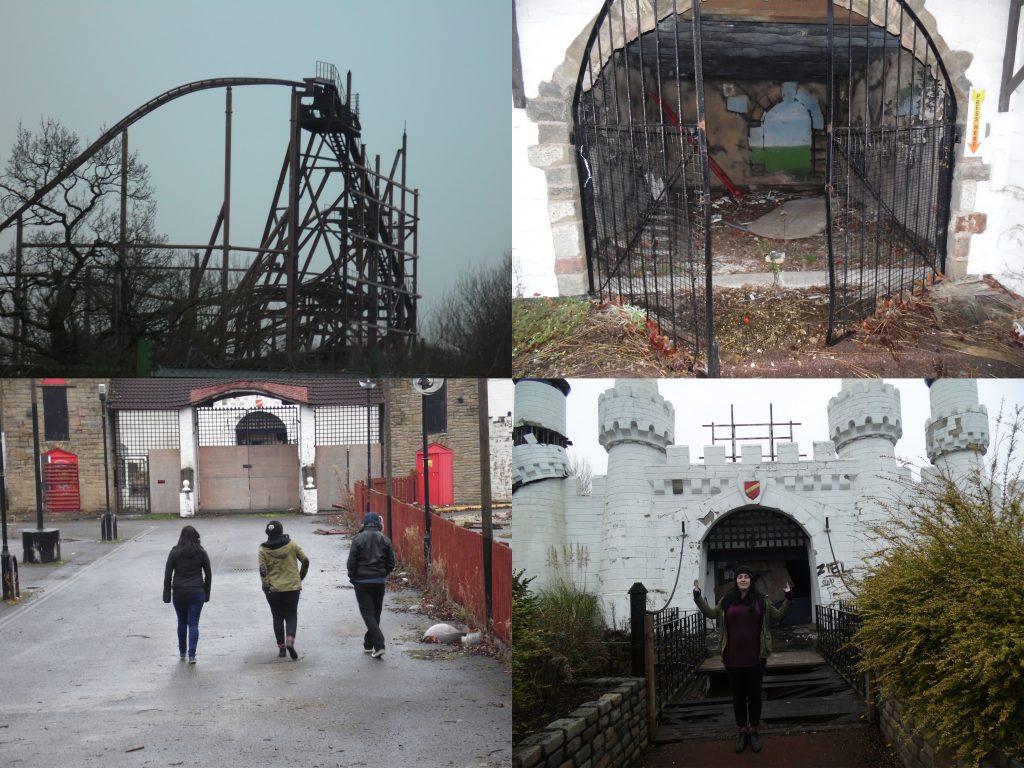
. These pictures of an abandoned fair ground in Lancashire are haunting. The unstable, skeletal frame of a roller coaster, the unlocked cage that once housed a model dragon – now looted, the hollowed out castle and gates that once held so much promise and excitement. It’s all here left to decay, its character still alive, its exploration locked off and exclusive to those with a curious nature. Abandoned buildings are amazing places (and sometimes dangerous so, explore carefully you venturing buccaneers!) Images like this are great resources for your notebook and for jotting out ideas for stories.
People
As an English teacher presently living in Warsaw, I get to meet some very interesting people with rich backgrounds. I get them to tell me stories, I get them to express ideas in English and to explain situations that tell me about who they are and help them to express this. Meeting people is important – keep the subject about them, learn what you can and enrich your notes.
People are a great way to conduct your research. Get curious about somebody – tell them they have an interesting life and you’d like the chance to make some notes on them as a means of research and improving your craft. In most cases, people are glad to oblige.
Unlikely Places
As I already mentioned, interesting characters emerge in unlikely places. I’m from the small, proud, Northern town of Wigan, Lancs. This post-industrial lacklustre is a place of character and home to unlikely characters, many of which are very talented artists. The Wigan music scene, for instance, was huge in the late 90’s up to the early 00’s. I was among this privileged crowd and part of a sudden and unexpected movement of wannabees and pros, mingling and shaking things up musically, making for a really interesting and divergent experience of artistic personalities. The stories here are countless – some of which made it into locally legendary songs and poetry. Artists feeding off society, while feeding a reciprocating society and influencing it to feed more art. A synthesis performance to which writers are inundated always. Find that crowd, keep your jotter handy.
TO SUM UP
A quick rundown of the habits you want to keep as a writer, regarding notations:
- Eavesdropping – It’s cheeky, but sometimes unavoidable. Writers are nosy bastards. Be nosy.
- Vocabulary – that word you just read that you’re sure is a French borrowing – or maybe it’s English it’s just so strange you’ve never come across it before. Write it down – define it!
- Dream book – keep a collection of those crazy, wonderful, sometimes scary dreams you have.
- Capture feelings – thoughts – impressions – reflections. Get deep. Get meta-fictional. Get under the skin of the observation.
- Be a detective – use your memory, exercise it. Try to recall your day. Studies show most people remember the beginning and end of their days but not the middle. Work on those illusive details – fill in the abstract using your imagination.
- Sketch and templates – doodle, draw, keep your mind busy – use real people as templates for fictional characters – or learn to add something from real people to fictional characters you already know. Experiment
- Draw in your books!!!
This last one is considered a cardinal sin by some literature folk. Books are sacred, (especially older texts) – they are sacrosanct. It’s true, there are some things I would never scribble on. I would never, for example write something in a book that was over 300 years old, or write something on Jack Kerouac’s original manuscript or accidentally mistake it for toilet roll. Nevertheless, I would write in a new print of Beowulf I just bought from Waterstones, or something I picked out of a store randomly out of curiosity. These are books you should, nay, ought to write in! Build you vocabulary, underline new words, underline nice, prosaic meters, highlight and draw things, make connections, get busy in those things. Make them yours!

Leave a Reply