
Writing and choosing your genre is the conceptual phase of your book, and it can be a lot of fun. There are some key details to cover here, important for grounding your work on a good foundation. This will help you to understand the two essential questions I always start with.
What am I writing?
Who is it for?
Let’s get into it!
Choosing Your Genre
Okay – so you like horror or maybe you like fantasy, and you’ve a rough idea of what you want. But then you start writing. And oh boy those gears just jam right up. Your story doesn’t always cruise out the drive right away. But there are some things you can do to keep that wonderfully creative engine of yours well oiled.
Set your genre. Then, you’re going to pick out two crucial things that will help you to conceptualise and understand what you’re really writing about.
Key Elements
Make a list of typical tropes found in your chosen genre. Writing a crime story? The murderer is the first character the MC meets. (It can be a cliché, a stereotype, get it all down.) This is important because it will help you familiarise what you know, but also highlight and research some things you didn’t.
Key Examples
Find main examples of well-known works in this genre. You’re going to list out titles as well as authors, short stories, films, shows, find those key examples. You are going to need these later. At some point, an agent or publisher is going to ask you – who are your influences and why? These examples will formulate your answer.
Target Audience for Your Genre
Next, when choosing and writing your genre, you’re going to need to know who you are writing for. A general profile doesn’t need to be in-depth at this point. For now, we can put something as simple as people who like scary stories. Put an age to them, feel free to look up statistics of people’s age group in your genre. We’ll need to consider other factors like gender and ethnicities. This will help you explore writers you may not have heard about and look deeper into other cultures covering similar genres in unique and interesting ways.
Then you’re going to list out some key things like interests and preferences. The better you know your intended target audience the more chance you have at crafting an authentic tone and discussing your work confidently. Remember, this is an early notation stage so we don’t need to get too robust at this point.
Your Audience Matrix
This part is real easy. The idea is to compare your notes and discover Key Overlaps in values between your audience and your genre. Make a table with 3 columns. Title them Genre, Audience and Overlaps. List out from your notes the audience and the genre in the first two columns. As you do more research, look for points of interest that Overlap between the two segments and note them in the 3rd column. Once you’ve done that, you may have potentially uncovered insights you ordinarily wouldn’t have considered. Always keep your research sources listed somewhere, like in the Notes section of the template I will provide at the end of this read.
A Basic Genre Wheel
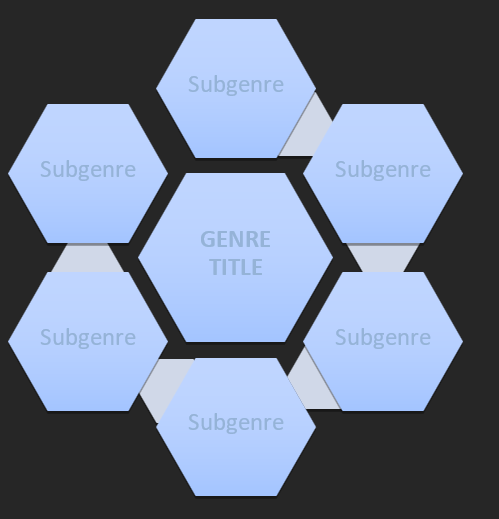
There are a few ways to do this. I tend to go with a large bubble in the middle linking with smaller bubbles around the side. Or, as provided in the template, you can structure the wheel something like this.
You will want to begin with putting your chosen genre in the centre field. Then you can explore the subgenres around it. Make as many as you can think of, feel free to do more than one wheel if you’re out of space.
The idea for this exercise is to flesh out all the potential categories, even ones that don’t interest you. Why? Because we need to know what our target audience likes, not just what we as writers want.
Genre Mapping

For this, we’re going to use a map. You can make or generate your own. For this, I used Azgaar’s Fantasy Map Generator. But there are others, like Inkarnate for instance. The places you put onto this map are going to represent the subgenres.
I prefer to print this sort of thing than work digitally, but you do what’s comfortable. Map out where your audience fits and to find where your story can offer something new and different.
Think about those interests you researched earlier. Which plots would they likely be drawn to? Why? Get your research and notes and begin plotting those markers.
How they connect to a genre and subgenre will help you better decide what kind of concept you wish to work with – an who will likely enjoy it.
A Genre Spectrum
Here’s a real simple one. You’re going to take your genre and place it on a continuum. This can be as long as your arm, the more information you have the better.

Take your main genre on one side. On the other you can take it’s polar opposite. You’re going to list as many hybrid genres that you can think of that go in between. Think about how concepts may go together, or maybe even find something that hasn’t been done before! Use this section to also write out your audience appeal, decide from your notes and ideas who would gravitate to one of these potential hybrid genres?
Don’t Forget Venn Diagrams
Venn Diagrams are basically overlapping circles. Each circle will be a different genre. Where they overlap you can note which intersections are most relevant to your target audience. The purpose here is to find new values that you can weave into your narrative when it comes to drafting.
It’s up to you how you want to make the Venn Diagrams. You can make your own, or if you’ve a flare for the artistic, you can bring out the designer in you and use a drawing compass. Or you can just use the template I keep banging on about.
Help yourself to my worksheet templet for Establishing Genre
Also you can find the PDF version here: Establishing Genre For Print
It’s free and it’ll help you get a nice start on getting your genre down. Remember, if you like these materials, drop in anytime and pick up a worksheet.
Keep readings and writing well!
