The Family Metaphors of Invincible
Amazon’s gory animated series, Invincible, can teach us something important about family metaphors. And how the differences in these metaphors frames two, incompatible world-views. That of the Strict Father – and the Nurturant Parent family. (Spoilers ahead.)
Frames & Conceptual World-Views
Before we get into the meat of Invincible, I want to layout a little background. Language is littered with thousands of conceptual metaphors. You get your world-view from a set of conceptual frames in your life experience. To get an idea of what a frame is, think of a restaurant. What can you find there? A Maître D, Cooks, Waiters, Tables, Music – all these comprise the restaurant frame, (with some overlap in the ‘business’ frame.)
Each of the entailments can also call back the restaurant frame. For example, when you think of a Maître D or a Cook, you associate the restaurant. Therefore, it is through the structures of frames that words find meaning. They express how we subconsciously understand reality and the values we each hold. Depending on your life experience, your culture, your background and family, your frames can bring about different values and beliefs, all grounded in the metaphors we use to communicate our ideas.
Frame Semantics
Frame Semantics was discovered by the late Charles Fillmore, professor of Semantics at UC Berkley. In 1977, a trial in Boston came to the attention of Charles Fillmore and George Lakoff. At the time, a doctor was being tried for murder after conducting an abortion. What Fillmore and Lakoff noticed were the differing frames used by the defence attorney and prosecutors. The defence used the word foetus while the prosecuting attorney used the word baby. That is to say, this was a clash of world-views, values and differences in how each side perceived the situation. Above all, it was a clash of two world-views that tie into morality, moral authority, family and, by extension, politics.
Viltrumite Values – Strict Father Family Metaphors
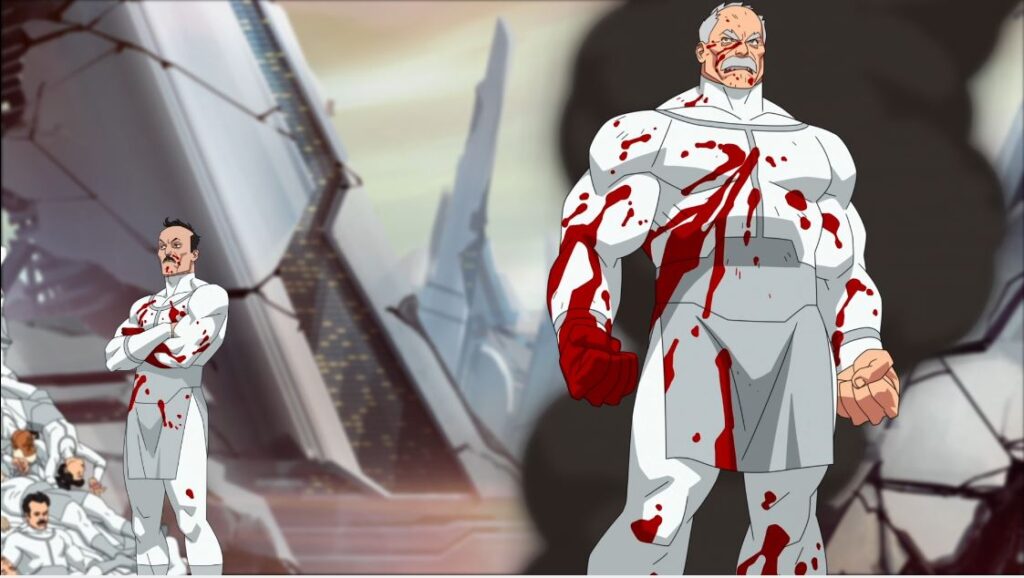
Morality is about well-being and all our ideals are based around what is best for us and how we ought to live. For instance, fairness, justice, virtue, tolerance, freedom, compassion etc. For Omni-Man, what is right is strength. And just like physical strength, moral strength must be built upon – no pain, no gain! The denial of pain is also a form of self-denial and discipline. The values of these family metaphors hold that punishment and pain can be good for you in service of something greater, the moral ideal itself, discipline. Spare the rod and spoil the child. Stiff upper lip. Take it on the chin.
On the surface, Omni-Man comes across as an up-standing citizen, somebody who has saved the world from peril time and again. The moral strength metaphor considers Evil as a physical force that one must be able to stand-up to.
THE MORAL STRENGTH METAPHOR
Being Upright > Being Good
Being Low > Being Bad
Falling > Doing Evil
A Destabilising Force > Evil (Internal & External)
Strength (To Resist) > Moral Virtue
[Philosophy In The Flesh – Lakoff & Johnson]
Somebody morally weak will not be able to stand up to evil and so will often commit evil. This metaphor regards moral weakness as immoral and sees a lack of self-control, and self indulgence (the refusal to engage in self-denial) as immoral.
Courage & Willpower
If the evil is an internal evil, then Willpower is necessary to overcome it, and is tied to resistance (physical) of the flesh. The seven deadly sins categorise internal conflicts and antagonists for the internal evil. On the other hand, external evil requires Courage to overcome fear and hardship. When Omni-Man tells Mark the truth about his past, he explains that it took all their strength and courage to destroy the weak to make Viltrum an unstoppable force.
On Moral Authority & Moral Order
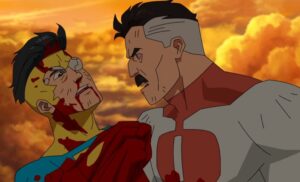 Moral authority is linked closely with physical control, such as that of a parent over a child. In the family metaphors modelled by Moral Authority and Moral Order, the father has total control and must be obeyed. As a Viltrumite on Earth, Omni-Man does not uphold his true values, but synchronises with the opposite moral structure of Nurturant Parent. This is only made clear during Mark’s confrontation with his all powerful father and the mask is finally off. To quote Omni-Man:
I was wrong to raise you as a human! I should have prepared you better, taught you more. Your life has been soft and painless. You’re a Viltrumite in blood only. Well your true education begins – now!
Paternalism is about parental authority in the family. There are legitimate reasons for authority, for instance preventing your child from endangering themselves and physically stepping in to save them. Whereas absolute authority deems that the child has a moral obligation to obey their parents no matter what.
Moral Order Metaphors
There are many different kinds of moral authority. Omni-Man happens to be almost god-like in his power and a master over his son. Since the Viltrumites are hardened by war and violence, their culture projects a clear hierarchical one with the strongest of them, Grand Regent Thragg, at the top. The moral order is a type of Folk Theory of Natural Order based on physical dominance and has some biblical and religious linkages. The dominance hierarchy looks like this:
God is naturally more powerful than people (& has moral authority over people.)
People are naturally more powerful than nature (moral authority over animals, plants, objects etc)
Adults are more powerful than/have moral authority over children
Men are more powerful than/have moral authority over women.
The Folk Theory here mixes with the ‘natural’ metaphor to make a hierarchy of power relations, moral superiority and authority. This obliges people to their duties and their roles within a Viltrum society. Furthermore, it is an example of a framing we can all clearly recognise, even though we may not have lived it.
Consequences Of The Moral Order
Omni-Man retains his responsibility towards his son, Mark. When his son first gets his powers, Omni-Man is keen to train him, although, initially reserved about it. This reservation is later revealed because he knows he will have to kill Mark if he gets in his way, or if Mark does not see things on his terms. Omni-Man’s ‘loyalty’ to Viltrum brings to the foreground his true values and beliefs. He tells Mark that he loved his mother, Debbie, like a ‘pet’ a subhuman category in the hierarchy of this moral order.
In Philosophy In The Flesh, there are consequences to this metaphor of Moral Order that lead to a repugnant and dangerous world-view, Quote:
The metaphor legitimises a certain class of existing power relations as being natural and therefore moral. In this way, it makes certain social movements, such as feminism, appear to be unnatural and therefore counter to the moral order. It legitimises the view that nature is a resource for humans and that humans should be good stewards of that resource…It undermines alternative views of nature.
In short, the Moral Order metaphor gives us a window into the meaning of fascism, and how people may fall in line to their duties by framing their understanding of reality, through this world-view, as upright and virtuous. After all, Omni-Man truly believes Earth will benefit from being subservient to Viltrum. But, there is just one small matter within this character’s internal struggle that’s worth exploring.
Nurturant Parent Family Morality
The principle value here is that for children to be fulfilled and happy in life and to become nurturant themselves. It involves caring for others, living as happily as possible and finding meaning from mutual interaction and care. This model puts empathy at the forefront with cooperation and kindness and the maintenance of social ties as supportive pillars. To do this requires strength, respect, self-discipline and self-reliance that emerges through caring and being cared for. Debbie, Mark’s mother and Omni-Man’s wife, represents the Nurturant Parent and upholds these values. During the scene where Omni-Man is beating Mark to death, he slips into a memory, a flashback of his younger son playing baseball. It’s at this point Debbie reminds Omni-Man:
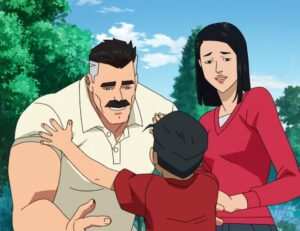
Look at Mark! You and I, we made him. He’s ours. When he feels joy, we feel joy. See that look on his face? How can you see that and not feel the same way? As we get older it’s harder to feel that.
Her nurturing attitude extends to Omni-Man here, teaches him the ways of people on earth, and for a moment she reaches him and he feels that joy. This pivotal moment is what ultimately saves Mark’s life in the future and prevents Omni-Man from killing him. He had not the willpower to battle this internal conflict and so, in the end, he flees the planet to retain his self-denial and recuperate his integrity.
Strict Father Vs The Nurturant Parent
The nurturant Parent frame is very different from the Strict Father frame, but they share a commonality. Both moral systems assume their children will carry on the values of their upbringing. Parents of the strict model will teach their children to pull themselves up by their bootstraps, and tighten their belts. They’ll teach them that the world is cruel and you must be strong and not emotionally burdened in order to face it. In this way the child takes self-discipline into adulthood and disciplines others. On the other hand, the Nurturant Parent hope that their model of love and care is incorporated to eventually become self-nurturant (to take care of one’s self) and others. The nurturant model also has some religious links to the Virgin Mary in Catholicism, and in the kabbalistic traditions in Judaism. Both models understand strength differently, yet both subscribe to Moral Strength.
It’s worth mentioning that the lived experience of family will seldom measure up to these two idealised family metaphors. They are conceptual metaphorical values that say something about our cognitive world-view. When we think about political messaging, when we listen to presidential speeches, we hear these frames and metaphors take center stage. Family values play a huge role here. And so too does empathy. The type of leaders leaning either Democrat or Republican, Tory or Labour, can reflect either a Strict Father tone of voice, or a Nurturant Parent, depending on the values of the demographic they wish to address.
Family Values in Political Speeches
The speech writers for Obama’s campaign understood their political messaging needed to be tied into family, unity, empathy and nurturance. I am my brother’s keeper. I am my sister’s keeper. E pluribus unum. Out of many, one. Obama emphasised one United States of America, and he ran on Hope. By contrast, Trump’s campaign to Make America Great Again framed the country as broken, disunited, emphasised wealth, money, jobs, and touted the need for a strong leader who has the strength and courage to tell it as it is and fight the real evil and external forces of China, or Isis or Mexican immigrants. Trump ran on a campaign of hate and fear.
Argument Is Struggle & The Family of Man Metaphor
One of the first intuitive things we learn about childhood is that Argument is Struggle. [This maps onto our language in terms of Argument is War metaphors, which you can read more about, here.] We learn about struggle and argumentation together, and this later extends to more violent iterations in later life. What’s important to notice here, is that just like in the courtroom abortion case, the values of the two moral world-views discussed will not align. One sees the other as weakness, while other sees one as depraved. This difference produces a tension, an on-going struggle to resolve our differences and alter how we perceive our reality.
In Philosophy In The Flesh, Lakoff and Johnson explore THE FAMILY OF MAN METAPHOR, which frames the family metaphors as humanity in one large family. It binds a moral obligation to all people, and calls us to treat one another as we do our own family. This framework entails family, children, moral relations, moral authorities, family morality and nurturance as human kind, human being, universal relations, authorities, moralities and universal moral nurturance. As a model, it certainly feels more inclusive. Perhaps future political messaging will speak of unity and inclusion with the Family of Man Metaphor in mind. If we accept that empathy can change the mind of a dangerous bi-conceptual thinker like Omni-Man, who knows, maybe there’s hope in its real world practical application as well.

Leave a Reply